Being a mathematician, I am having difficulty getting my fluid-dynamics papers accepted for publication. So I have come to the realization that mathematics and physics papers are vastly different.
The methodology in a mathematics paper is at least as important as the result; there are cases where a shorter proof generates almost as much excitement as the original.
It appears that for physicists, the result is paramount and the methodology is mainly for vetting the results. To develop an elegant theory which provides results which are already known is of no interest; there must be some lack or deficiency in a known result for the physicist to read past the abstract. And that lack or deficiency must be stated up front; one of my papers was rejected because it didn't tell a story.
Mathematicians tend to read a paper from start to finish and are delighted by footnotes with unexpected connections to other fields. The Journal of Fluid Mechanics nearly forbids footnotes in their instructions for authors.
There are variations among physics journals as well. For journals with an engineering bent, stating that a coefficient of 0.450 is actually sqrt(2)/pi is probably best left out.
Monday, May 11, 2020


Saturday, September 21, 2019
Real-time interactive mathematical marbling
Blake Jones has done some righteous coding, creating a GPU implementation of the Oseen flow in paint marbling algorithm which executes so fast that it renders the marbling from arbitrary stylus movements interactively in real time! The first video on his Turing clouds webpage shows the system in action.
Thursday, February 7, 2019
Mathematical Marbling How-To
http://people.csail.mit.edu/jaffer/Marbling/How-To
Pst-marble (and documentation) is a CTAN package for the LaTeX document system. If you have LaTeX and CTAN installed on your computing device, then you can create marblings locally. https://www.latex-project.org/get/ has the downloads and instructions for installing LaTeX and CTAN on GNU/Linux, MacOS, and Windows.
For those with a web-browser, it is easy to create marblings online. Papeeria.com provides an online LaTeX workbench with free and paid accounts. The marbling example files will render in less than one minute; so a free account is sufficient for exploring. If you create more complicated designs, you can upgrade to a paid Papeeria account or install LaTeX and CTAN on a (larger) computing device.
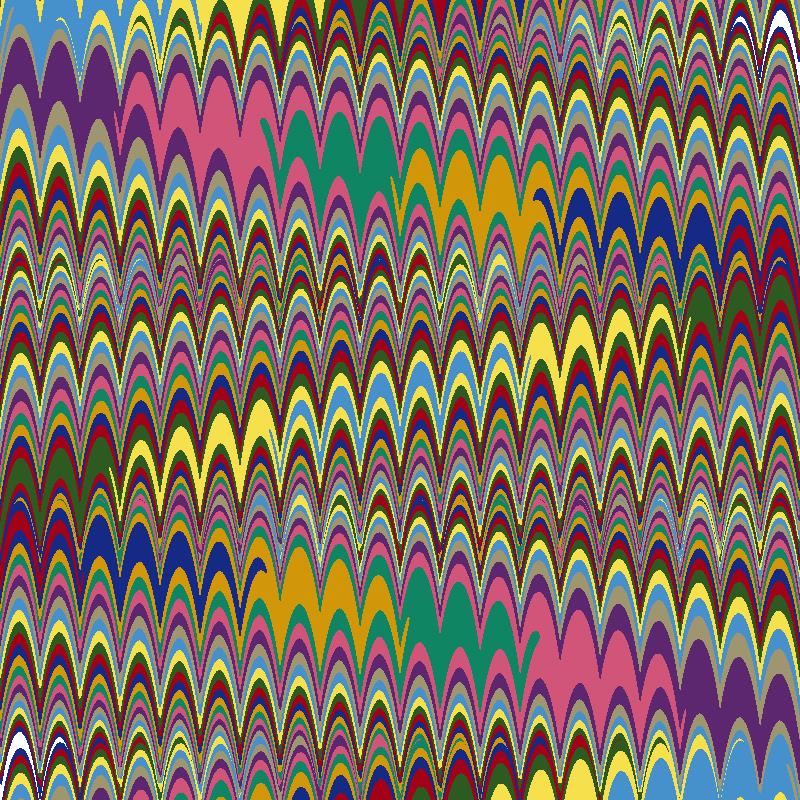
Low resolution rendering of Nonpareil.tex
Returning to the Nonpareil.tex code: After
the \psMarble line there are several sections bounded by
curly braces { and }.
The
The
Comment out four lines of the
0 0 48 [(c28847) [231 204 155] [0.635 0.008 0.094]] 25 concentric-rings Next, uncomment the first two
"
Raking left and right increases the number of color bands. The next step will rake downward with 25 tines. While we could specify their positions as 25 numbers between brackets, pst-marble offers a utility for generating evenly spaced tines:
The pst-marble reference card gives brief descriptions of all the
Copyright © 2019 Aubrey Jaffer
Paint marbling is a process of dropping colored paints onto a liquid bath and raking (combing) them to create intricate designs. Based on my mathematical theory of marbling, Jürgen Gilg, Manuel Luque, and I have created the pst-marble software to enable anyone with an internet browser to create their own digital marbled designs.
Pst-marble (and documentation) is a CTAN package for the LaTeX document system. If you have LaTeX and CTAN installed on your computing device, then you can create marblings locally. https://www.latex-project.org/get/ has the downloads and instructions for installing LaTeX and CTAN on GNU/Linux, MacOS, and Windows.
For those with a web-browser, it is easy to create marblings online. Papeeria.com provides an online LaTeX workbench with free and paid accounts. The marbling example files will render in less than one minute; so a free account is sufficient for exploring. If you create more complicated designs, you can upgrade to a paid Papeeria account or install LaTeX and CTAN on a (larger) computing device.
- Download pst-marble-v1.4.zip (15 kB) onto your computing device.
- Go to http://Papeeria.com and create a free account for yourself and a "project" with whatever name you like.
- From the top left pull-down select Upload Project, then Choose files and select pst-marble-v1.4.zip which you just downloaded. Then click Open.
- In the Project tab you should then see a list of filenames. The files with capitalized first letter and ending with .tex are the marbling example files.
- Click on Nonpareil.tex and you will see lines of text which are a small marbling program. Find the Papeeria Compile pull down and click on Nonpareil.tex. In less than 30 seconds a colorful design will appear in the PDF tab (you may need to install a PDF viewer on your device).
Low resolution rendering of Nonpareil.tex
colors= section accepts RGB colors in three formats.
- [0.906 0.8 0.608]
- Red, green, and blue color components between 0 and 1 in square brackets.
- [231 204 155]
- Red, green, and blue color components between 0 and 255 in square brackets.
- (e7cc9b)
- Red, green, and blue (RRGGBB) hexadecimal color components between 00 and fF in parentheses.
% is the comment character
in .tex files. Text to the right of % is
ignored to the end-of-line. Try commenting out some color
lines, then click on Papeeria's Compile button; you should
see fewer colors in the resulting marbling PDF.
The
actions= section in Nonpareil.tex
specifies the marbling design through a sequence of numbers
(arguments) and commands separated by whitespace. The system
is a bit unusual in that the command is to the right of its
arguments. The leftmost two arguments to most of the commands
are the x and y coordinates of the center of the
marbling action. 0 0 for the first two
arguments specifies the center of the design. The
visible x and y for a square image are from -500 to
+500; but the virtual tank is infinite in size.
Comment out four lines of the
actions= section so that
it looks like this; then Compile:
      0 0 48 colors 25 concentric-rings
%      90  [-150 450] 100 750 31 rake
%      -90 [-150 450] 100 750 31 rake
%      180 [ 25 50 0 tines ] 30 200 31 rake
%      0 230 shift
You should now see concentric colored rings in the PDF viewer. These are produced by
concentric-rings command:
- x y Ri [rgb ...] n concentric-rings
- Places n rings in color sequence [rgb ...] centered at location x,y, each ring having thickness Ri.
colors argument refers to the color
sequence from the colors= section. It can be replaced
by a literal color sequence; for instance:
0 0 48 [(c28847) [231 204 155] [0.635 0.008 0.094]] 25 concentric-rings Next, uncomment the first two
rake lines so that
the actions= section looks like this;
then Compile:
      0 0 48 colors 25 concentric-rings
      90  [-150 450] 100 750 31 rake
      -90 [-150 450] 100 750 31 rake
%      180 [ 25 50 0 tines ] 30 200 31 rake
%      0 230 shift
- θ [R ...] V S D rake
- Pulls tines of diameter D at θ degrees clockwise from the positive y-axis through the virtual tank at velocity V, moving fluid on the tine path a distance S. The tine paths are spaced [R ...] from the tank center at their nearest points.
90 [-150 450] 100 750 31 rake" rakes two tines from
left to right.
"
-90 [-150 450] 100 750 31 rake" rakes two tines from
right to left. The tine tracks are distinct from the previous two
because they are rotated 180 degrees. It is important to offset the
tines so that rakes in opposite direction do not cancel each other
out. You can see this cancellation by changing [-150
450] to [-300 300] in both lines.
Raking left and right increases the number of color bands. The next step will rake downward with 25 tines. While we could specify their positions as 25 numbers between brackets, pst-marble offers a utility for generating evenly spaced tines:
- [n S Ω tines]
- The tines command and its arguments are replaced by a sequence of n numbers. The difference between adjacent numbers is S and the center number is Ω when n is odd and S/2−Ω when n is even.
[2 600 -150 tines] is equivalent to
[-150 450]. For the 25 tine rake, uncomment
the rake line in actions= so that it looks like this;
then Compile:
    0 0 48 colors 25 concentric-rings
    90  [-150 450] 100 750 31 rake
    -90 [-150 450] 100 750 31 rake
    180 [ 25 50 0 tines ] 30 200 31 rake
%    0 230 shift
The top quarter of the marbling is less densely threaded than the
rest of the marbling. This is because, by raking downward without a
compensating upward raking, the whole design has been moved
downward. To recenter it pst-marble offers:
- θ R shift
- Shifts tank by R at θ degrees clockwise from vertical.
shift line will center the nonpareil
design; the value 230 was arrived at by trial and error:
    0 0 48 colors 25 concentric-rings
    90  [-150 450] 100 750 31 rake
    -90 [-150 450] 100 750 31 rake
    180 [ 25 50 0 tines ] 30 200 31 rake
    0 230 shift
The nonpareil design is common in marbling, and is the basis for
more complicated designs as well. You can easily alter the
appearance by changing the actions= code.
The pst-marble reference card gives brief descriptions of all the
actions= commands. The next
installment in this tutorial series
explains how to rake curves.
Copyright © 2019 Aubrey Jaffer
| Topological Computer Graphics | ||
| Go Figure! | ||
Wednesday, January 16, 2019
Mathematical Marblilng Software

Jürgen Gilg and Luque Manuel have collaborated to create the pst-marble package on CTAN.org which lets you create your own mathematical marblings using LaTeX. https://ctan.org/pkg/pst-marble
http://pstricks.blogspot.com/2018/09/the-marbled-paper-with-pstricks.html
show nice examples of marblings you can create with pst-marble.
You can now create pst-marble designs online! The first tutorial (about the nonpareil pattern) is https://voluntocracy.blogspot.com/2019/02/mathematical-marbling-how-to.html
Wednesday, October 10, 2018
The Lamb-Oseen Vortex and Paint Marbling

The image to the left shows the decay with time of the Lamb-Oseen vortex (starting from an impulse of circulation at the center point).

More about mathematical marbling.
Wednesday, August 15, 2018
Vortex marbling in Jupiter's great spot
 |
| Image from NASA's Juno spacecraft 2018-04-01 |
Friday, July 27, 2018
Bubbles in Marbling
 | |
| Bubbles and parted paints |
While the formation of bubbles could be due to non-Newtonian fluid behavior, it is worth examining the conditions assuming a Newtonian fluid. A 25 mm diameter dowel submerged 12.5 mm will behave more like half of a 25 mm diameter sphere than a cylinder. If the kinematic viscosity (ν=0.001 m2/s) of the liquid is 1000 times that of water, then the Reynolds number is about 5, far less than the 90 needed to spawn vortexes. Re is inversely proportional to viscosity; reducing the kinematic viscosity by a factor of 10 raises Re to 50.
A half sphere of diameter d has buoyant-pressure (restoring force divided by cross-section area) of about 81 N/m2. Surface tension pressure (restoring force divided by cross-section area) of water is roughly 3.7 N/m2.
Drag is the force on the object moving through the tank fluid. There must be an equal and opposite net force on the liquid. Drag D for a sphere is the product of the friction coefficient CD, frontal area (π/4*d2), and dynamic head V2*ρ/2 (for water ρ=997). That force divided by the frontal area of the object is a pressure (suction actually).
A bubble will be formed if this suction behind the moving stylus is larger than the sum of the restoring forces at the liquid surface.
For ν=1000 mm2/s (1000 times that of water) the suction behind our 25 mm diameter dowel is 88 N/m2, which exceeds the restoring pressures 81 N/m2 and 3.7 N/m2, and bubbles can result.
The slower motions and smaller styluses that the St.Johns usually use have Reynolds numbers much smaller than 5. Thus the marblings they create don't evidence inertial effects (versus the mushroom designs of my previous post).
 | |
| "Mushroom" flow from straight strokes |
In water, a 5 mm cylinder moving at 2 cm/s would shed vortexes 3 cm apart. A 1 mm diameter stylus moved in a straight path at 5 cm/s would not shed vortexes.
So existing evidence of Karman (shed) vortexes is only likely to be found in marbling produced on a tank filled with water.
Monday, July 9, 2018
Vortexes in Marbling
This image from the on-line Getty collection is busier, but shows some of the same features.
 | ||
| Autograph album of Johann Joachim Prack von Asch Publication date 1587 In the collection of the Getty Research Institute https://archive.org/stream/gri_33125012902959#page/n151 |
"Vortex shedding in Water" from "Harvard Natural Sciences Lecture Demonstrations" shows vortexes being shed from a cylinder at flow speeds in the range of marbling strokes.
My work has focused on laminar and Oseen flows https://arxiv.org/abs/1702.02106 in Newtonian fluids which successfully model most common marbling techniques.
At the lowest Reynolds numbers is Stokes flow, where the passage of the stylus displaces the liquid only temporarily. The next range of Reynolds numbers produces Oseen flow, where viscous forces dominate inertial forces. Straight strokes of finite length result in persistent movement along the stroke and rotation to both sides of the stroke. As the inertial forces grow relative to viscous forces, instabilities such as vortex shedding appear (Re ≥ 90). Much higher Reynolds numbers (≥ 40000) can produce turbulence.
To answer vortex question and to better quantify the fluid dynamics parameters of marbling, Dan and Regina St.John, the Chena River Marblers, recently hosted a session where we performed experiments using their equipment and expertise.
The idea was to increase the Reynolds number of marbling strokes by increasing the stylus size and speed until instabilities such as vortexes appeared. We increased the stylus size to 25 mm, but instabilities did not appear. We increased the speed to the point that it created a tear and bubbles in the paints, but no vortexes appeared. The tear indicates that the assumption that the fluid is Newtonian may not be valid; and the properties of carageenan used to make the "sizing" in the tank are complicated. Note: my later post finds that Newtonian fluids can produce these behaviors.

Reynolds number being the characteristic length times the velocity divided by the kinematic viscosity, the only other thing to try was reducing the viscosity. Diluting the sizing by half with water resulted in a sea change. Instead of fluid motion stopping when the stylus stopped, it would glide for as long as 5 seconds before coming to rest, showing that inertia was in play. Stylus strokes at speeds around 25.cm/s (which is fast for marbling) created the mushroom shapes pictured. Although the St.Johns were able to find an example of this shape in one of their books, it is not a common marbling motif. Looking back at the photo of the 16th century marbling, mushrooms are present.

Are these mushrooms due to flow instabilities? No. The mushrooms appear where the stylus was stopped. In vortex shedding, the vortexes are shed to alternating sides of the ongoing stroke. Even for a fast stroke, the train behind the stylus was smooth and without wiggles.
We know from the video of vortex shedding that it happens in water. Viscosity near that of water may be required in order to see it in marbling.
There is more of interest here. The mushrooms in our marbling have smaller mushrooms inside of them. In the photograph, I have outlined mushrooms at 3 different scales. The mushroom in the smallest box ls less obvious than the others; perhaps because the bands of color comprising it are larger relative to its size.
Pure Oseen flow is reversible; reversing the flow at the origin returns the system to its original state. With its sub-mushrooms, the mushroom flow does not look reversible.
Sunday, July 8, 2018
Fractal Scaling of Population Counts Over Time Spans

It's been 7 months since my last post. The process of downsizing to a smaller home last winter put my projects on hold.
Although fractals have stubbornly refused to appear in my investigation of self-similar surface roughness, they have shown up at my day job as a data scientist at Digilant.
Investigating the possibility of combining weekly counts of unique user IDs, I discovered that the L^p-norm does so with surprisingly good accuracy on digital advertising datasets. The L^p-norm implies a scaling law. My son Martin (who also works at Digilant) noticed that the scaling law exponent is a fractal dimension. The L^p-norm and scaling law are implied by the Pareto distribution of lifetimes in a population. This link between the L^p-norm and fractal dimension should have application beyond counting populations.
We wrote a paper about these results at https://arxiv.org/abs/1806.06772
Friday, December 8, 2017
The Physics of Marbling
Last week I spoke on The Physics of Marbling at the Form in art, toys and games workshop at the Isaac Newton Institute for Mathematical Sciences in the University of Cambridge!
The four day workshop had many fascinating presentations on a wide variety of topics. Videos for most of the talks are available.
 |
| I am the one in the bright blue jacket. |
Sunday, August 6, 2017
Mixed Convection from an Isothermal Rough Plate

In March 2017 the roughness of the aluminum plate was reduced from 3mm to 1mm. I installed it in the wind-tunnel and started running experiments. The forced convection measurements were nearly 30% higher than expected!
I examined nearly every aspect of the physical device and its mathematical model. The fan-speed calibration was found to be sensitive to the distance between the test surface and the wind-tunnel wall. Conditioning the rpm-to-speed conversion on the plate's orientation improved the earlier data taken with the plate with 3mm roughness.
When the plate is not parallel to the wind-tunnel, the forced and mixed measurements are affected. With the 3mm roughness plate, the alignment had been controlled within a couple of millimeters over the plate's 305mm length. The 1mm roughness plate seemed to require stricter tolerances. Using a caliper, I am able to control the alignment to better than 1mm.
The primary cause of the measured excess was that, when the height of the posts had been reduced, the size and spacing of the posts had not been reduced. At high wind-speeds the convection from the flat post tops was exceeding the "fully-rough" mode of convection. The model incorporating this phenomena is developed in the "Rough to Smooth Turbulence Transition" section of my "Mixed Convection from an Isothermal Rough Plate" paper.
Writing a paper forces one to revisit all the questions and anomalies that occurred during research and experiment. Understanding, resolving, and testing all of these issues has taken months. I would appreciate any proof-reading or critiquing that others might provide before I submit it for publication.
Wednesday, February 8, 2017
Oseen Flow in Ink Marbling

Mathematical modeling of ink marbling has long been a fascination of mine. My Ink Marbling web pages have presented emulations of a number of marbling techniques. But the raking techniques modeled were either paths across the whole tank or circular paths.
Pictorial ink marbling designs are created using short strokes, where a stylus is inserted into the tank; moved a short distance; then extracted. There seems to be no way to adapt the line or circle draws to short strokes with endpoints.
Having bought a copy of Boundary-layer theory (Hermann Schlichting et. al.) for my convection project, I started reading from the beginning. It didn't take long until I found a description of Oseen flow on page 115 (chapter IV, very slow motion). Its streamline figure looked very promising. After further research I have written: Oseen Flow in Ink Marbling arXiv:1702.02106 [physics.flu-dyn].

Unlike a cylinder in a 2-dimensional flow, the velocity field induced by an infinitesimally thin stylus can be exactly solved in closed form. In this sense, marbling is the purest form of Oseen flow.
The partial differential equations solved include conservation of mass (divergence=0), but not conservation of momentum (Navier-Stokes). It's not clear how much momentum is imparted by the stylus, or how that imparting momentum changes with time.
Liquid marbling is sensitive to the speed of a stylus moving through the tank. At low speeds the induced flow is laminar; at high speeds the flow becomes turbulent. Both are used by marblers, but only the laminar flow is possible to solve in closed form.

Sunday, October 2, 2016
Mixed Convection from a Rough Plate
Its been a long time since my last blog entry; there are new developments.
After completing the vertical convection measurements, I returned the Convection Machine to its horizontal orientation and did some runs to make sure everything was as before. But things were not the same.
With the rough side facing down, the transition where mixed convection dropped below the linear asymptote had disappeared. Varying parameters did not restore the dip. Changing inclination of the plate; tilting the wind-tunnel; resealing the cardboard around the fan; nothing I tried restored the dip. Something has permanently changed in the wind-tunnel or the plate.
So I reran the measurements of horizontal upward and downward facing mixed convection. The new curves match simple L2 and L4 norms of the forced and natural convection components. My guess of what changed has to do with the suspension of the plate. The vertical suspension was a single long wire which, after hooking around the a top corner post, wrapped across the back and hooked around the other top corner post. Wrapping around the back compressed the back sheet and insulation against the back side of the rough plate. Perhaps the pressure closed gaps in the glue between aluminum and insulation.

Having data for horizontal forced flow with 3 plate orientations, it was time to measure downward forced flow with a vertical plate. Because vibration of the plate had caused excess convection with the single wire suspension, I added two wrap-around wires pulling in opposite directions to the plate suspension. This new suspension is quite rigid and works with the wind-tunnel in any orientation.

I added four legs to support the wind-tunnel upright with the fan drawing downward. I was expecting either L2-norm mixing or for convection to drop below the natural level when the natural and forced components were equal. But it was neither! I devised a model which transitions between L2 and L4 norm that matched the measurements well; it is detailed in my paper.

Because the opposed mixing was unexpected, aided mixing had to be tried. It also turned out to involve a transition between L2 and L4 norms, but with a gentler transition.
I have finished writing the article and put it and the supplementary data on http://people.csail.mit.edu/jaffer/convect
As described in the paper, the next step is to shave 4.mm off the rough side of the plate and repeat the measurements.
After completing the vertical convection measurements, I returned the Convection Machine to its horizontal orientation and did some runs to make sure everything was as before. But things were not the same.
With the rough side facing down, the transition where mixed convection dropped below the linear asymptote had disappeared. Varying parameters did not restore the dip. Changing inclination of the plate; tilting the wind-tunnel; resealing the cardboard around the fan; nothing I tried restored the dip. Something has permanently changed in the wind-tunnel or the plate.
So I reran the measurements of horizontal upward and downward facing mixed convection. The new curves match simple L2 and L4 norms of the forced and natural convection components. My guess of what changed has to do with the suspension of the plate. The vertical suspension was a single long wire which, after hooking around the a top corner post, wrapped across the back and hooked around the other top corner post. Wrapping around the back compressed the back sheet and insulation against the back side of the rough plate. Perhaps the pressure closed gaps in the glue between aluminum and insulation.

Having data for horizontal forced flow with 3 plate orientations, it was time to measure downward forced flow with a vertical plate. Because vibration of the plate had caused excess convection with the single wire suspension, I added two wrap-around wires pulling in opposite directions to the plate suspension. This new suspension is quite rigid and works with the wind-tunnel in any orientation.

I added four legs to support the wind-tunnel upright with the fan drawing downward. I was expecting either L2-norm mixing or for convection to drop below the natural level when the natural and forced components were equal. But it was neither! I devised a model which transitions between L2 and L4 norm that matched the measurements well; it is detailed in my paper.

Because the opposed mixing was unexpected, aided mixing had to be tried. It also turned out to involve a transition between L2 and L4 norms, but with a gentler transition.
I have finished writing the article and put it and the supplementary data on http://people.csail.mit.edu/jaffer/convect
As described in the paper, the next step is to shave 4.mm off the rough side of the plate and repeat the measurements.
Monday, June 13, 2016
Mixed Convection from a Vertical Rough Surface
I turned the wind-tunnel on its side and hung the plate vertically as shown in the photograph.

These graphs show that my mixed convection model is successful from natural through forced convection for horizontal and vertical rough plates with forced flow perpendicular to the natural flow. The leftmost red dot in each graph is the natural convection (Re=0) for that orientation; it is placed at Re=1000 so that it can appear on the graph.


The L4-norm for downward convection indicates that the interaction between the downward mode and forced convection is more competitive than the fairly cooperative L2-norm of the vertical and upward modes.
Horizontal downward and vertical natural convection from the rough plate match that expected from a smooth plate. Horizontal upward convection matches assuming that the upper (rough) surface convection is reduced by 93% of the non-forced convection from the four adjoining sides. In order to test if horizontal upward convection is the same for rough and smooth, I will cover the rough surface with a flat sheet of aluminum and repeat the test.
I have started writing a paper titled "Mixed Convection from a Rough Plate". Which journal should I submit it to?

These graphs show that my mixed convection model is successful from natural through forced convection for horizontal and vertical rough plates with forced flow perpendicular to the natural flow. The leftmost red dot in each graph is the natural convection (Re=0) for that orientation; it is placed at Re=1000 so that it can appear on the graph.


The L4-norm for downward convection indicates that the interaction between the downward mode and forced convection is more competitive than the fairly cooperative L2-norm of the vertical and upward modes.
Horizontal downward and vertical natural convection from the rough plate match that expected from a smooth plate. Horizontal upward convection matches assuming that the upper (rough) surface convection is reduced by 93% of the non-forced convection from the four adjoining sides. In order to test if horizontal upward convection is the same for rough and smooth, I will cover the rough surface with a flat sheet of aluminum and repeat the test.
I have started writing a paper titled "Mixed Convection from a Rough Plate". Which journal should I submit it to?
Saturday, June 4, 2016
Fan Windspeed
With the wind-tunnel fan being phase-locked now, the speed variability which plagued earlier speed measurements should be reduced or eliminated.
The process of conducting the measurements for these graphs finds this to be the case. Although some variability remains above 3 m/s (1000 r/min), at slower speeds the anemometer readings are steady after the phase-lock-loop settles. The measured traces are in blue; the black curve is that used in convection calculations. This first graph is for the wind tunnel with horizontal plate.

This second graph is with the wind tunnel laying on its side with the plate vertical.

An earlier post found that the kink just above 2 m/s is due to the anemometer; it remains. Friction in the anemometer makes the measurements below fan speeds of 700 r/min unreliable; below fan speeds of 200 r/min the anemometer reads 0.0.
The process of conducting the measurements for these graphs finds this to be the case. Although some variability remains above 3 m/s (1000 r/min), at slower speeds the anemometer readings are steady after the phase-lock-loop settles. The measured traces are in blue; the black curve is that used in convection calculations. This first graph is for the wind tunnel with horizontal plate.

This second graph is with the wind tunnel laying on its side with the plate vertical.

An earlier post found that the kink just above 2 m/s is due to the anemometer; it remains. Friction in the anemometer makes the measurements below fan speeds of 700 r/min unreliable; below fan speeds of 200 r/min the anemometer reads 0.0.
Saturday, May 7, 2016
How to Phase-Lock a Fan
Using an auto-transformer to reduce the voltage to the wind-tunnel fan
in order to reduce its speed didn't work below 45 r/min (it ran for a
while and stopped). So I modified The Convection Machine to toggle
the fan power with a solid-state relay controlled by micro-processor.
Consider the shaft of the wind-tunnel fan. Every full rotation of the
fan results in 3 micro-processor interrupts. A phase-accumulator
register is incremented by the desired rotation rate (in r/min) 1200
times a second and decreased by 24000 every time a fan blade crosses a
light beam. If the fan rotates at the desired rotation rate, then the
average phase-accumulator value is constant. If the fan is too slow,
then the phase-accumulator value increases with time; if it is too
fast, then the phase-accumulator value decreases with time.
Phase-locking is the process of controlling the fan-speed so that the
average phase-accumulator value is 0. Such feedback systems are
tricky to stabilize. My fan controller operates in one mode when the
desired speed is less than 400 r/min and a different one otherwise.
At high speeds, the fan speed is roughly proportional to the average
voltage applied, which is proportional to the duty cycle of applied
voltage. The phase accumulator operates as described above. Its
instantaneous value is compared with a variable which decrements from
the upper phase range bound to 0 ten times a second. If greater, the
fan is turned on, otherwise it is turned off. Some of the
instabilities of the fan speed may be due to a centripetal switch
disconnecting the starter capacitor and hooking in the running
capacitor, which increases the loop gain of the system. The change in
gain causes the system to overshoot and undershoot the desired r/min
with long settling times.
At low speeds each pulse of power incrementally increases the fan
speed while friction continually slows it. The solid-state relay has
"zero-crossing" control, so only complete half-cycles of 60 Hz power
are applied to the fan motor. The combination of the motor windings
and phase capacitor stores energy, so the acceleration of the rotor is
delayed from the application of power. At low speeds the rotational
inertia of the rotor introduces 90 degrees of phase shift. The
microprocessor clock is not synchronized to the line voltage, so the
minimum pulse width varies with the relative phase, another source of
loop gain variation.

This photo shows the new fan-speed control. The number on the
7-segment displays is the rotation rate in r/min measured every
second. The right 3 dial switches set the desired rotation rate.
This video which shows the phased-locked fan in
operation at a variety of speeds. The low light level was necessary
so that the stroboscopic interaction of camera shutter with the
scanned 7-segment display didn't render the numbers unreadable. If
you turn up the audio volume you can hear the fan chugging as its
power is switched on and off.
in order to reduce its speed didn't work below 45 r/min (it ran for a
while and stopped). So I modified The Convection Machine to toggle
the fan power with a solid-state relay controlled by micro-processor.
Consider the shaft of the wind-tunnel fan. Every full rotation of the
fan results in 3 micro-processor interrupts. A phase-accumulator
register is incremented by the desired rotation rate (in r/min) 1200
times a second and decreased by 24000 every time a fan blade crosses a
light beam. If the fan rotates at the desired rotation rate, then the
average phase-accumulator value is constant. If the fan is too slow,
then the phase-accumulator value increases with time; if it is too
fast, then the phase-accumulator value decreases with time.
Phase-locking is the process of controlling the fan-speed so that the
average phase-accumulator value is 0. Such feedback systems are
tricky to stabilize. My fan controller operates in one mode when the
desired speed is less than 400 r/min and a different one otherwise.
At high speeds, the fan speed is roughly proportional to the average
voltage applied, which is proportional to the duty cycle of applied
voltage. The phase accumulator operates as described above. Its
instantaneous value is compared with a variable which decrements from
the upper phase range bound to 0 ten times a second. If greater, the
fan is turned on, otherwise it is turned off. Some of the
instabilities of the fan speed may be due to a centripetal switch
disconnecting the starter capacitor and hooking in the running
capacitor, which increases the loop gain of the system. The change in
gain causes the system to overshoot and undershoot the desired r/min
with long settling times.
At low speeds each pulse of power incrementally increases the fan
speed while friction continually slows it. The solid-state relay has
"zero-crossing" control, so only complete half-cycles of 60 Hz power
are applied to the fan motor. The combination of the motor windings
and phase capacitor stores energy, so the acceleration of the rotor is
delayed from the application of power. At low speeds the rotational
inertia of the rotor introduces 90 degrees of phase shift. The
microprocessor clock is not synchronized to the line voltage, so the
minimum pulse width varies with the relative phase, another source of
loop gain variation.

This photo shows the new fan-speed control. The number on the
7-segment displays is the rotation rate in r/min measured every
second. The right 3 dial switches set the desired rotation rate.
This video which shows the phased-locked fan in
operation at a variety of speeds. The low light level was necessary
so that the stroboscopic interaction of camera shutter with the
scanned 7-segment display didn't render the numbers unreadable. If
you turn up the audio volume you can hear the fan chugging as its
power is switched on and off.
Saturday, March 19, 2016
Make Square Opening by Drilling Five Round Holes
In making a speed control for an off-the-shelf electric fan, I needed to install a square power receptacle in the phenolic box I am using for the speed dial switches and 7-segment displays. Phenolic is brittle and does not machine well with the woodworking tools that I have, chipping instead of cutting.
A straightforward way to cut the hole would be to drill a hole, disassemble a coping saw and reassemble it with the blade through the hole, and sawing. But the small size of the box would limit the saw strokes to a few centimetres.
A reciprocating "Sabre" saw might do the job but is hard to control.
Twist drill bits seemed to work the best of my tools on the material, and I have a good selection of sizes. How close to a square opening can one create by drilling a small number of round holes? It turns out that I can come fairly close. There are two ways the problem can be posed, the largest opening bounded within the square or the smallest opening just larger than the square. I am interested in the latter; the other solution can be had by scaling.
The idea is to drill holes on the diagonals near the 4 corners such that the corner touches the rim of the hole. One then drills a hole in the center which is enough larger than the square so that its points of contact with the square are points of contact with the 4 smaller holes. If the diameter of the 4 corner holes is reduced, then the diameter of the center hole must be increased in order for it to intersect the smaller holes and the square.
Let L be the length of one side of the square, R be the radius of the center hole, and r be the radius of the corner holes. The center of each corner hole is L/sqrt(2)-r from the center of the square so that the rim lies on the corner point. The furthest that the corner holes exceed the desired square is
r+(L/sqrt(2)-r)/sqrt(2)-L/2 = r-r/sqrt(2) = r*(1-sqrt(1/2))
The furthest that the large center hole exceeds the desired square is R-L/2. Desired is:
R-L/2 = r*(1-sqrt(1/2))
The other constraint is that the rim of the center hole and the rim of the corner hole intersect on the side of the square. The distance from the middle of the side to the intersection of the side with the large hole is x
R^2 = (L/2)^2 + x^2
The distance from the corner to the intersection is r*sqrt(2). So:
L/2 = r*sqrt(2) + x
R, r, and x scale with L. Let L = 1.
R^2 = 1/4 + x^2
1/2 = r*sqrt(2) + x
R-1/2 = r*(1-sqrt(1/2))

Solving this system:
r = 1/(4+sqrt(2))
r = L * 184.69903125906464e-3
R = L * 554.097093777194e-3
The diameters when L = 1.125 are:
d = 415.57282033289544e-3
D = 1.2467184609986863
I made the holes with a 3/8 inch twist drill and a 1.25 inch hole saw. A 7/16 bit would have been closer in size.


The flange on the outlet covers the non-square parts of opening.
A straightforward way to cut the hole would be to drill a hole, disassemble a coping saw and reassemble it with the blade through the hole, and sawing. But the small size of the box would limit the saw strokes to a few centimetres.
A reciprocating "Sabre" saw might do the job but is hard to control.
Twist drill bits seemed to work the best of my tools on the material, and I have a good selection of sizes. How close to a square opening can one create by drilling a small number of round holes? It turns out that I can come fairly close. There are two ways the problem can be posed, the largest opening bounded within the square or the smallest opening just larger than the square. I am interested in the latter; the other solution can be had by scaling.
The idea is to drill holes on the diagonals near the 4 corners such that the corner touches the rim of the hole. One then drills a hole in the center which is enough larger than the square so that its points of contact with the square are points of contact with the 4 smaller holes. If the diameter of the 4 corner holes is reduced, then the diameter of the center hole must be increased in order for it to intersect the smaller holes and the square.
Let L be the length of one side of the square, R be the radius of the center hole, and r be the radius of the corner holes. The center of each corner hole is L/sqrt(2)-r from the center of the square so that the rim lies on the corner point. The furthest that the corner holes exceed the desired square is
r+(L/sqrt(2)-r)/sqrt(2)-L/2 = r-r/sqrt(2) = r*(1-sqrt(1/2))
The furthest that the large center hole exceeds the desired square is R-L/2. Desired is:
R-L/2 = r*(1-sqrt(1/2))
The other constraint is that the rim of the center hole and the rim of the corner hole intersect on the side of the square. The distance from the middle of the side to the intersection of the side with the large hole is x
R^2 = (L/2)^2 + x^2
The distance from the corner to the intersection is r*sqrt(2). So:
L/2 = r*sqrt(2) + x
R, r, and x scale with L. Let L = 1.
R^2 = 1/4 + x^2
1/2 = r*sqrt(2) + x
R-1/2 = r*(1-sqrt(1/2))
Solving this system:
r = 1/(4+sqrt(2))
r = L * 184.69903125906464e-3
R = L * 554.097093777194e-3
The diameters when L = 1.125 are:
d = 415.57282033289544e-3
D = 1.2467184609986863
I made the holes with a 3/8 inch twist drill and a 1.25 inch hole saw. A 7/16 bit would have been closer in size.


The flange on the outlet covers the non-square parts of opening.
Thursday, February 18, 2016
Vertical Natural Convection
 Unexpected results for downward convection at small-angles raised
the question of whether vertical natural convection is the same for
rough and smooth plates. This photo shows the plate suspended
vertically by steel wire from the two boards above. The ambient
temperature sensor is taped to the table leg. I measured the
natural convection over three temperature ranges as was done in the
other natural convection runs.
Unexpected results for downward convection at small-angles raised
the question of whether vertical natural convection is the same for
rough and smooth plates. This photo shows the plate suspended
vertically by steel wire from the two boards above. The ambient
temperature sensor is taped to the table leg. I measured the
natural convection over three temperature ranges as was done in the
other natural convection runs.
If there is less convection than expected, then it could be due to heat from one side reducing the convection of a side above it, as happens in the upward facing case.
But slightly more convection than expected was measured. As the plate is no longer in the wind tunnel, modeling the emissivity of the room as 0.9 (versus 0.8 for the wind tunnel) brings the simulation into reasonable agreement with measurement. It thus appears that, at least for laminar flows from rectangular plates, natural convection from a rough surface has the same magnitude as convection from a smooth surface.
The graph below is linked to a pdf of the measurements and simulations of natural convection in level and vertical orientations.

Saturday, February 6, 2016
Mixed Convection
As my blog post
Upward Natural Convection
details, there is no guarantee that natural convection of my plate
with the rough surface facing up behaves in a manner which can be
modeled. The air warmed by the insulated back and sides rises
adjacent to the heated rough surface which draws air towards its
center. So how strong is this effect? Measured with peak
temperature differences of 15 K, 10 K, and 5 K, the
measured upward natural convection is about half that predicted.
But looking at the natural convection components, the deficit is
roughly equal to sum of the back and side convective heat flows!
With the rough surface facing down, the mix of convective and radiative heat loss from the four sides matters little because both are subtracted from the overall heat loss. But when the rough surface faces upward it does matter; side convection reduces the rough surface convection while thermal radiation does not. Creating a plot of downward natural convection at a range of temperature differences allows evaluation of simulated mixtures. As the fraction of simulated radiative heat loss increases, the slope connecting the measured points increases. The graph below shows the fit when the effective radiative height of the side is 41% of its actual height, and the effective convective surface area is adjusted to fit:

With this rough estimate of the relative strengths of convective and radiative heat loss, we are now ready to see whether the effect of the sides on the top surface can be reasonably modeled.
The plot below compares upward convection correlations with total non-radiative heat flow minus 77% of the (modeled) sides and back natural convection. There is less variation from point to point because upward natural convection is three times stronger than downward natural convection. "Horizontal Hot Top" is my generalization of the four conventional upward convection correlations.

The unexpectedly close match above lends support to the idea that air heated by the sides is drawn over the upper surface of the plate, reducing the effective temperature difference between the plate and air, and can be modeled as a reduction of upward convection by an amount proportional to the side convection.
Now that I have convection measurements at low fan speeds which are comparable in magnitude to natural convection, the next step is to evaluate mixed convection (with the rough surface facing upward).
Just as there was no guarantee of a workable model for the interaction of the sides with the top in still air, there is no guarantee of a model of that interaction in forced air. Needed is a generalization matches the model developed for V=0 and matches the forced correlation as V grows.
The graph below shows the correlation I have arrived at for upward convection (see simulations). It assumes that mixed convection for the four short sides is the L4-norm of the natural and forced convections and that 77% of only the natural component of the back and sides is absorbed by the convection of the (upward-facing) rough surface.

If the L4-norm mixing for the short sides is instead L2, the increase in natural convection from the sides reduces the top surface convection, spoiling the upward-convection match with L2-norm (gray dashed line) and other L-norm exponents (best is about L2.3).
Here are the calculated values of convection from all six sides of the plate at windspeeds from 0 to 4 m/s and ΔT=11K:
With the rough surface facing down, the mix of convective and radiative heat loss from the four sides matters little because both are subtracted from the overall heat loss. But when the rough surface faces upward it does matter; side convection reduces the rough surface convection while thermal radiation does not. Creating a plot of downward natural convection at a range of temperature differences allows evaluation of simulated mixtures. As the fraction of simulated radiative heat loss increases, the slope connecting the measured points increases. The graph below shows the fit when the effective radiative height of the side is 41% of its actual height, and the effective convective surface area is adjusted to fit:
With this rough estimate of the relative strengths of convective and radiative heat loss, we are now ready to see whether the effect of the sides on the top surface can be reasonably modeled.
The plot below compares upward convection correlations with total non-radiative heat flow minus 77% of the (modeled) sides and back natural convection. There is less variation from point to point because upward natural convection is three times stronger than downward natural convection. "Horizontal Hot Top" is my generalization of the four conventional upward convection correlations.
The unexpectedly close match above lends support to the idea that air heated by the sides is drawn over the upper surface of the plate, reducing the effective temperature difference between the plate and air, and can be modeled as a reduction of upward convection by an amount proportional to the side convection.
Now that I have convection measurements at low fan speeds which are comparable in magnitude to natural convection, the next step is to evaluate mixed convection (with the rough surface facing upward).
Just as there was no guarantee of a workable model for the interaction of the sides with the top in still air, there is no guarantee of a model of that interaction in forced air. Needed is a generalization matches the model developed for V=0 and matches the forced correlation as V grows.
The graph below shows the correlation I have arrived at for upward convection (see simulations). It assumes that mixed convection for the four short sides is the L4-norm of the natural and forced convections and that 77% of only the natural component of the back and sides is absorbed by the convection of the (upward-facing) rough surface.
If the L4-norm mixing for the short sides is instead L2, the increase in natural convection from the sides reduces the top surface convection, spoiling the upward-convection match with L2-norm (gray dashed line) and other L-norm exponents (best is about L2.3).
Here are the calculated values of convection from all six sides of the plate at windspeeds from 0 to 4 m/s and ΔT=11K:
I had expected L4-norm mixing for upward convection. So these results will require modifications to my theory of mixed convection.
insulated
back+ 2 ⋅ parallel
side+ 2 ⋅ windward
leeward= total vs rough @ windspeed 53.1mW/K 55.3mW/K 55.3mW/K 0.272W/K 0.467W/K 0.0m/s 55.2mW/K 55.4mW/K 55.4mW/K 0.274W/K 0.484W/K 0.12m/s 60.4mW/K 55.5mW/K 55.4mW/K 0.280W/K 0.520W/K 0.25m/s 65.0mW/K 55.9mW/K 55.9mW/K 0.286W/K 0.666W/K 0.50m/s 68.5mW/K 57.3mW/K 57.6mW/K 0.296W/K 1.18W/K 1.0m/s 71.0mW/K 61.5mW/K 63.4mW/K 0.318W/K 2.22W/K 2.0m/s 72.6mW/K 72.4mW/K 78.4mW/K 0.371W/K 4.36W/K 4.0m/s
Wednesday, January 27, 2016
Forced Convection on Convection Machine 2.0
The new back eliminated the dual modes seen earlier with peak
ΔT=15K. Reducing the r/min to m/s conversion by 2%
(which is within the ± 3% error band of the anemometer)
and adjusting the breakpoint results in a beautiful fit!

The points at Re=3545 and Re=5231 could be following either the Smooth Turbulent Asymptote or the Transition Model; it's too close to tell. The reason that the Transition Model has less convection than the Smooth Turbulent Asymptote below Re=6000 is because the leading edge of the boundary layer is modeled as thinner than the roughness; but division by the local characteristic length, 0, is undefined at the leading edge.

The points at Re=3545 and Re=5231 could be following either the Smooth Turbulent Asymptote or the Transition Model; it's too close to tell. The reason that the Transition Model has less convection than the Smooth Turbulent Asymptote below Re=6000 is because the leading edge of the boundary layer is modeled as thinner than the roughness; but division by the local characteristic length, 0, is undefined at the leading edge.
Subscribe to:
Posts (Atom)
