Being a mathematician, I am having difficulty getting my fluid-dynamics papers accepted for publication. So I have come to the realization that mathematics and physics papers are vastly different.
The methodology in a mathematics paper is at least as important as the result; there are cases where a shorter proof generates almost as much excitement as the original.
It appears that for physicists, the result is paramount and the methodology is mainly for vetting the results. To develop an elegant theory which provides results which are already known is of no interest; there must be some lack or deficiency in a known result for the physicist to read past the abstract. And that lack or deficiency must be stated up front; one of my papers was rejected because it didn't tell a story.
Mathematicians tend to read a paper from start to finish and are delighted by footnotes with unexpected connections to other fields. The Journal of Fluid Mechanics nearly forbids footnotes in their instructions for authors.
There are variations among physics journals as well. For journals with an engineering bent, stating that a coefficient of 0.450 is actually sqrt(2)/pi is probably best left out.
Showing posts with label Mathematics. Show all posts
Showing posts with label Mathematics. Show all posts
Monday, May 11, 2020


Friday, December 8, 2017
The Physics of Marbling
Last week I spoke on The Physics of Marbling at the Form in art, toys and games workshop at the Isaac Newton Institute for Mathematical Sciences in the University of Cambridge!
The four day workshop had many fascinating presentations on a wide variety of topics. Videos for most of the talks are available.
 |
| I am the one in the bright blue jacket. |
Tuesday, December 21, 2010
Marbling the Torus
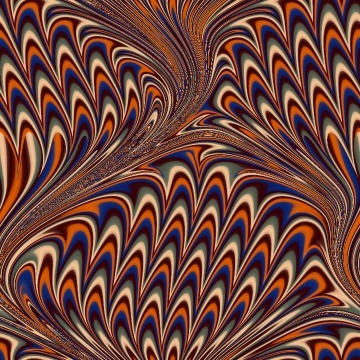
I have cleaned up the math on Marbling the Torus and changed my scripts to oversample the images, resulting in less graininess.
Monday, October 12, 2009
Biological Space-Filling Curves
My (Aubrey Jaffer) work on multidimensional space-filling curves is acknowledged in October 9th Science's cover article: "Comprehensive Mapping of Long-Range Interactions Reveals Folding Principles of the Human Genome".
See supplemental-material link.
See supplemental-material link.
Subscribe to:
Posts (Atom)
